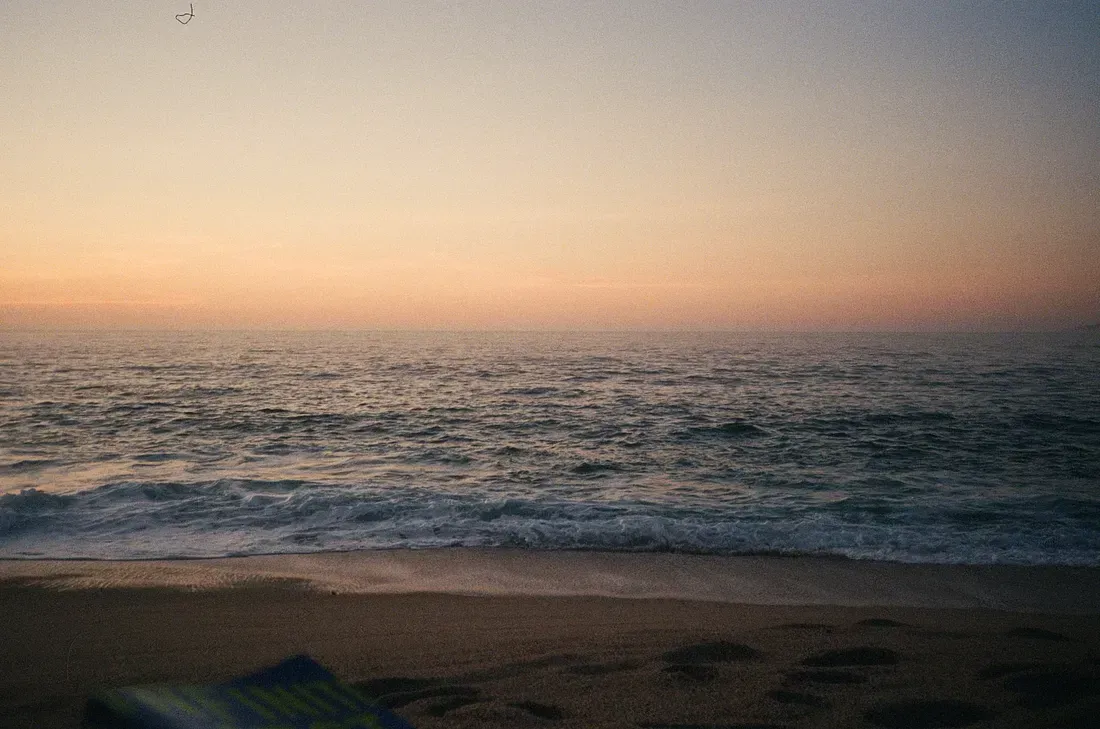
I bought plants, using them as a tangible representation for my own growth, redecorated with bright pinks and oranges, visited nearby parks, and took up the harmonica. I tried things, and in trying things, I didn’t just start feeling free of him, I started feeling free in my life. In the ultimate expression of this newfound freedom, I drove the PCH from San Francisco to Carmel by the Sea, where I stayed in a small guesthouse in the mountains with massive windows and low bookshelves covered in crystals and affirmation cards. By day, I tasted wines at a local vineyard and watched the sunset with my current read and a small massif of sea glass piled on the towel at my feet. By night, I cooked pasta from a small Italian café and dragged a blanket onto the deck so I could look up at the stars. And when it was too early to sleep, but too late to do much else, I sat in the silence, the idle hours triggering the restless creator within.
It was my first solo vacation, it was my first time really playing with the world, and it further woke me up to the fact that I am. I am not my career. I am not my schedule. I am not the style of my room. I extend far beyond these things, and I will endure as these things shift and morph through the years. I had become shackled to my choices, to this universal notion that once you pick something, you have to stick with it. But making choices is merely a by-product of existence. They don’t come together to make you who you are. You are.
I only belong to other people as an idea, and I am not responsible for upholding that idea, even if, for most of my life, I have. I’ve operated under the weight that is, “what would people think if I (fill in the blank)?” But I didn’t sign a contract that said I’d always have expensive taste and the money to fund it. I wasn’t onboarded at Mom Friends for Life. I could stop being the spokesperson for veganism whenever I wanted to. And I could soften and be the exact opposite of what I had always been.
With one solo trip, with one or two meals on my own making conversation with a waiter who felt no guilt hanging around my table simply because I was unaccompanied, I had been set completely free.
I found in that freedom that things started to flow. Relationships that no longer served me — and perhaps never had — saw themselves out. The pop career I’d spent eight years nurturing came to a humbled, and triumphant finale. Knowing the world was big and as filled to the rim with possibility made excusing the things in my life that didn’t align with my truth impossible. If I had all the time in the world, if I didn’t need to worry about my lasting impact, why was I making up stories about all the superficial fluff I’d been unknowingly padding myself with?
With as much gentility as I could muster, I addressed the lingering bits of my psyche that were still fronting like an underclassman at a party made up of seniors: the parts of me that ran around LA doing hot girl shit hoping my ex would see, the instinct to place my entire worth in the time elapsed between sexual encounters and the fullness of my social schedule, the guilt-fueled exercise wheel I couldn’t seem to get off of.
The world was huge, nothing was personal, and time was plentiful. Suddenly, I had so much freedom, I felt drunk on it. Instead of forcing things, and rushing through my day, I placed my faith in divine timing and let life inform me. In this glamorization of flow rather than grind, I acknowledged that things happen behind the scenes, and the great panic, while always a whisper, no longer owned me.
I began approaching things with the emphasis on learning. I wanted to listen, be courageous, and experience. Dating with those intentions at my core took all the pressure off. I didn’t need to find anything meaningful. Everything was meaningful simply because my mandate changed. I was there to figure out how to date consciously, be patient, and not give myself away in the process.
After I met my soon-to-be partner, I was careful not to scold myself for the times I fell into old habits. I obsessed. I waited around instead of making other plans. I was not immune to impossible situations, which love would almost always be. Part of taking back your power is being gentle with yourself when faced with impossible situations. Instead of giving in to toxic inner monologue and entertaining worst case scenarios, I developed methods to find my way back to myself and offered myself kind reminders whenever I lost my footing: I am happening, I am working out even if things around me aren’t. Rebranding my experience to lift myself up, posing it as an opportunity to grow and learn rather than a thing that was happening to me without my consent, never left me in a position of feeling helpless.
When we moved our lives across the country, and made our home together, I had to choose repeatedly not to let his experience become my experience. Freedom is fleeting in that way. It requires upkeep. And the best way I know to maintain my freedom is to go out into the world.
While he looked for work, I walked our neighborhoods. Sometimes, I’d bring a book, finding the cadence of my footfalls soothing. They’d act as a complete erasure of thought, freeing up my attention span to focus on the words before me. Sometimes I’d leave the house with nothing and be intentional with my gaze. Sometimes I’d put music on and dance in the sunlight or in golden halos cast by streetlights, moving intuitively, springing around the street without much care for who could see. I call these dips into suburbia my “Main Character Walks,” paying homage to the movies I’d grown up with, where every teen’s experience was magnified by a good song and the will to let the rest of the world fall away.
I took myself on dates to the dive bar a short drive from my house. I’d sip amber lagers, read, browse Instagram, and write small lists of my favorite titles for the wait staff who asked me for book recommendations. I filled my home with pretty things. I stretched before work, opening my hips up lovingly to support me as I sat at my desk all day. I played jazz as I cooked and read by candlelight in the bath. I journaled daily, leaned into whimsy, resumed therapy even though I’d “graduated” from therapy years before, and every time I was sad, I let myself be sad.
I think we forget that we can be whatever we want to be in this life. In moments of desperation, when the world starts to close in once again, I remind myself that I can move to a seaside town and work as a waitress, go back to school for journalism, or become a foster mom. I don’t need anybody to see the world. In fact, some of my most romantic moments have been the ones I spent totally on my own, writing a story about myself that inspires me. A story of grand triumph about a girl who reunites with possibility and figures out how to extend and endure beyond difficult conversations, breakups, bad days, and eras of feeling misunderstood.
I remember not long ago being told “you’re not the main character,” and finding the craze around that musing a bit backwards. There’s this idea that being inherently good requires self-sacrifice, that the experience of others should be as important to you as your own. But I believe in putting yourself first. In keeping it simple. You do you. Whatever that looks like. Whatever the fullest expression of you turns out to be. Not because your life is the only one that matters, but because tending to your own wounds, centering yourself and finding conscious presence allows for you to be there for others, to keep your eyes on the conflict in the Middle East, to listen to Black educators grieve generational and modern traumas, all without burning out.
Bad friends, bad endings, bad jobs, bad outcomes — life isn’t as personal as we think it is, life is only as personal as we make it. Part of self-preservation is remembering that the story you write about yourself is the only one that matters. This is not to say you should abandon your humanity and become devoted to individualism. This is to say that being an advocate, lending your voice to a cause — it requires clarity and alertness, things that come from taking good care of yourself. Afterall, when you’re ready to get back out on the road safely — with mindfulness of your car and an awareness of others — the only cracked windshield you need to worry about replacing is your own.